
Chess players remember too much
Losing and the weight of experience in your chessOne of the hardest things about losing in chess is that it can affect you in your next games. You’re still thinking about the mistake you made, the move you could have played, how you should be the one now playing on a higher board. You’re still beating yourself up over it so you can’t focus, and lose again.
Really bad losses can even affect you years later.
A big part of my chess improvement philosophy is learning from your own games, especially losses. You find a lesson, turn that into training, and apply that to your next game.
But even though your chess history contains the best training material, it also contains baggage: the pain, disappointment and self-hate from losing, and keeping those two things separate is a skill that isn’t talked about enough.
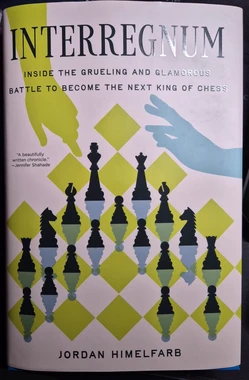
Jordan Himelfarb’s book, Interregnum follows the top players chasing the world title after Magnus Carlsen gave it up. We see how this baggage affects top players too, including how they need to be good at both remembering and forgetting.
It is an irony of the sport that greatness requires players whose otherworldly powers of memory helped propel them to the top to adopt, after a loss, the mindset of a goldfish.
The winner’s reset
At the 2024 Candidates in Toronto, Dommaraju Gukesh was only 17. He was playing his first Candidates, the final qualification tournament for the World Championship match. Against the best players in the world, he was bound to lose somewhere, and he lost in Round 7, the halfway point, to Alireza Firouzja. When you lose in a Swiss tournament, you usually get paired with an easier opponent after a loss, but in the Candidates, you have to play a top GM in every round.
So when it would be so easy to try and control the damage with a draw, or tilt and lose another game, it was impressive how he immediately bounced back with a win against Vidit Gujrathi, with the Black pieces too. He scored 3 wins and 4 draws in the second half, became the youngest challenger in history and later beat Ding Liren to become the 18th World Champion.
In Interregnum, we also see how other Candidates dealt with their defeats. (Note: I recommend the book for chess players and even non-players with a casual interest in the game, it’s well-written and researched)
The art of resetting
Rameshbabu Praggnanandhaa was the only other player to follow up a loss with a win with Black in the next round, though this was in the final round with nothing on the line against the tail-ender, Abasov. Pragg’s family seems to have built the reset into daily life:
Every morning, with his sister and mother, the grandmaster would recite Hindu mantras and prayers of devotion and humility. In the evenings, win or lose, Nagalakshmi would prepare dosas on a hot plate for her children. She believed the key to raising prodigies was never to apply pressure. “They should just enjoy it,” she said late in the tournament, Vaishali translating from Tamil, “They just have to let it go.”
His sister, Vaishali was playing in the Women’s Candidates at the same venue, and this passage reminded me of when I played against her in Bangkok in 2015. The first thing she asked after losing was “Where was my mistake?” She had emotionally moved on from the result a minute after the game, already focused on learning from it.
Their compatriot, Vidit, found resetting much harder. He would get into good positions in most games, but often fell into time trouble and lost. Even in the press conferences after he won, he’d dwell on losses from earlier in the tournament. At the same time, he won the fans’ hearts:
While other players walked briskly past the assembled fans as they entered the venue before each round, Vidit would stand for every selfie, sign every autograph. While other players would disappear after losses, forgoing the press conference, Vidit often showed up, sharing his insecurities and grief, just as he shared his pride and joy after victories.
I wonder if that openness that made him so likeable is connected to how long his losses stayed with him. Someone who feels so strongly and can’t hide it might also be accumulating more heavy baggage with each loss. Repressed repression.
The trouble with experience
On the other extreme to Gukesh, who perhaps didn’t feel the weight of expectation in his first Candidates, was Fabiano Caruana. In 2016, he went into the final round of the Candidates level with Karjakin but lost to him. In 2018, he won the event and lost to Carlsen only in the World Championships tie-breaks. In 2020–21, he again came close, finishing =3rd, a point behind Nepomniachtchi.
Such experience seems useful, but because he’s had those near-misses, it’s also harder to reset after a loss in the event. He knows the cost of one defeat, of working hard for two years and failing in the last game. He might have to take a risk but it’s failed him before. Or he might take a risk when he didn’t have to because he thinks his brain is suppressing the need to take risk, so he tricks himself into thinking he needs to...
With experience came haunting memories. And the more haunting memories, the more discipline required to be a goldfish, to begin each day afresh.
My nemesis
Reading about Caruana reminded me of my games against Australian GM, Temur Kuybokarov.
- 2017 Australian Open (Round 9, Board 3), loss as White
- 2019 Australasian Masters (Round 4), loss as White
- 2020 Australian Championships (4.1), loss as White
- 2021 Doeberl Cup (3.3), loss as White
- 2022 Begonia Open (6.1), loss as Black
In April this year, I was Black against him on top board in Round 5 of the Doeberl Cup, the biggest tournament in Australia, and I was playing some of my best chess. After 42.Ke3, I still had a minute and 40 seconds to decide between 42...Qe1+ and 42...Bxe6. After 42...Qe1+ 43.Kf4 Qxe6, I’d be a pawn up and much better. White would have to swap queens, after which I pretty much have no risk of losing, with h5 being a juicy long-term target for my bishop.
“But what’s the difference,” I asked myself. I can play 42...Bxe6 instead, and wherever White goes with the queen, I have even more options there: queen checks, take on h5, and it’s harder for White to navigate that than a bad endgame.
According to the broadcast, in this absolutely critical position I played 42...Bxe6 after only thinking for 12 seconds. All sense of danger had left me, that I committed the taboo of not checking if my opponent has any threats. I still had a minute and a half to calculate and double-check! I’m sure a part of me already thought the game was won, and just wanted to get there quickly. Finally, after 5 losses against him, I’ve played a great game and I’m stopping the streak. But until your opponent resigns, you haven’t won yet.
After 20 seconds, Temur played 43.Rxh6+, and I was rudely awaken from my reverie. White wins. The series of consecutive losses climbed to 6 over 9 years.
Lesson vs. Baggage
In the game review post, I suggested finishing this sentence after every serious game:
“This game showed me that I need to work on...”
Meanwhile, the baggage version sounds different:
“This game showed me that I am...”
So something like “I rush things when my opponent creates counterplay” is something you can train, by compiling those moments from your own games and looking for improvements or playing those positions against a training partner or engine. On the other hand, “I always choke in winning positions” feels honest but you’ve made it into a verdict about yourself, and those keep holding you down.
We can’t forget our losses easily, especially when we’re playing another game right after one. But keep in mind that you can always learn something from it afterwards and train so you can do better next time. The pain and disappointment, perhaps anger from losing can motivate some players to bounce back immediately. While that might work sometimes, I think it’s better to practice separating the loss as a result from something more personal, the belief that the loss is saying something bad about you.
GM (Goldfish Memory)
 Mas Gusat on Unsplash
Most of us stand somewhere between Gukesh and Caruana. We aren’t spring chickens with our whole futures ahead of us any more, but we don’t carry the heavy burden of having narrowly missed out on a World Championship. We all have good and bad memories, chess history. The aim is to let your past games teach you what to work on without letting them tell you who you are.
There could be no happiness, cheerfulness, hope, pride, immediacy, without forgetfulness.
—Friedrich Nietzsche, On the Genealogy of Morals / Ecce Homo
Free workbook
Thanks for reading. If you’re looking for a way to reset your chess, check out my free ebook, The Chess Improvement Reset. I created this to help chess players find what’s holding their chess back, what they’re struggling with and what they can change. There are guided exercises through which you can identify the bottleneck in your chess routine and come up with an experiment that will move you forward.
You may also like
 thibault
How I started building Lichess
I get this question sometimes. How did you decide to make a chess server? The truth is, I didn't. IM datajunkie
What most improvers are missing (a new GM explains)
Interview Part 2/2: how Rishi Sardana got from 1800 to IM, and advice for improvers IM datajunkie
Our 64 most memorable moves
Share a move you'll never forget for our community chess collection RuyLopez1000
The Secret History of Chess Engines
"It doesn’t mean Kasparov isn’t a deep thinker, just that you can bypass deep thinking in playing ch… CM HGabor
How titled players lie to you
This post is a word of warning for the average club player. As the chess world is becoming increasin… IM datajunkie