
Chess Improvement is a Spinning Top geometrically speaking...
A study of 1 Billion Games on Lichess and FICS.
Question 1.
A is better than B, and B is better than C.
Is A better than C?
---
The answer is not necessarily.
One example is Rock, Paper, Scissors.
 Rock, Paper, Scissors. By Original: EnzoklopEdit: OmegaFallon, CC BY-SA 3.0, Wikipedia Commons
This is called Non-transitivity. It's when there is no best strategy, because the strategy loops around like in Rock, Paper, Scissors. This forms a cycle.
The opposite is transitivity. It's when there is a best strategy. So A would be better than C. Scissors would be better than rock.
Transitivity occurs at the top and the bottom of skill levels in games. At the bottom there is worst play which gets beaten by all the other strategies. At the top there is best play which beats all the other strategies. At the middle, the strategies operate in cycles like Rock, Paper, Scissors. This cyclical organization is the opposite of the hierarchical and ordered organization that takes place at the low and high levels.
 At the top skill level is The Nash Equilibrium: This refers to a state where a player will not change their strategy. In the purple section (middle skill level) Strategy A can beat B, B can beat C, and C can beat A in a cycle. There are more non-transitive strategies in this level (purple). At the bottom it is the opposite of The Nash Equilibrium. This represents worst play, which cannot beat any other strategies. Measuring the Non-Transitivity in Chess. Sanjaya et al. (2022).
| Skill | Transitivity |
|---|---|
| High | Transitive |
| Medium | Non-Transitive |
| Low | Transitive |
Low and High skill levels result in more ordered and hierarchical strategies. If A beats B, and B beats C, then A usually beats C.
Medium skill levels result in cycling like Rock, Paper, Scissors. If A beats B, and B beats C, then C can beat A. But there can be a lot more than just 3 cycles.
This whole concept came from a paper by DeepMind researchers: Real World Games Look Like Spinning Tops. Czarnecki et al. (2020). DeepMind is the company that created AlphaZero, which used neural nets to defeat a version of Stockfish. Neural nets are now a part of modern-day chess engines, including Stockfish.
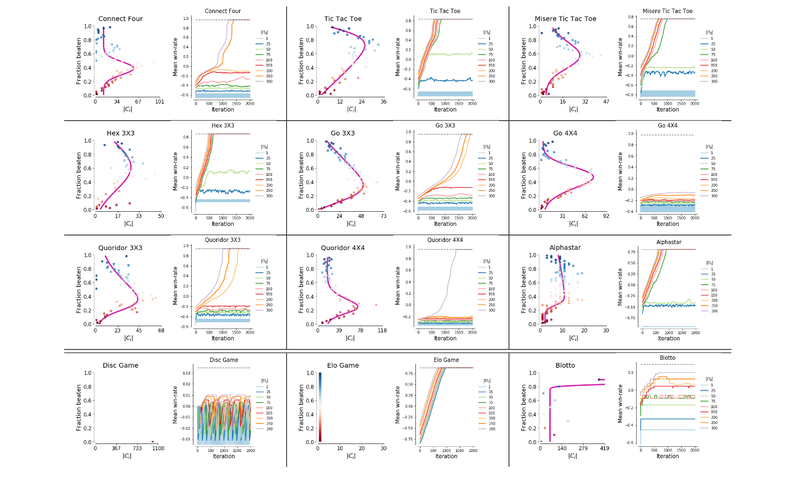
They hypothesized that Games of Skill include the 'Spinning Top geometry'. That is the 3D version of the graph above (shown in thumbnail). It represents everything that was said above.
"This paper investigates the geometrical properties of real world games (e.g. Tic-Tac-Toe, Go, StarCraft II). We hypothesise that their geometrical structure resembles a spinning top, with the upright axis representing transitive strength, and the radial axis representing the non-transitive dimension, which corresponds to the number of cycles that exist at a particular transitive strength. We prove the existence of this geometry for a wide class of real world games by exposing their temporal nature." - Czarnecki et al.
The bulge of the spinning top represents when the cycle chains are long. Like an expanded version of Paper-Scissors-Rock.
They used two methods to quantify cycling. The first is Nash Clusters, which are layers of strategies that are involved in a cycle, the bigger the cluster size, the more cycling. The second is counting the number of Rock-Paper-Scissors Cycles, the cycles with length 3. There will be more cycles of length 3, and larger Nash Clusters in the middle skill level range. They defined strategy by looking at the results of games between AI-agents, which were given different skill levels.
These methods confirmed their hypothesis. They found the 'spinning top' (3D version of a Gaussian curve) geometry for all the Games of Skill, which are defined through having the ability to progress and beat less experienced players as well as having a range of playing styles:
Can this be applied to chess?
The answer is yes.
Measuring the Non-Transitivity in Chess. Sanjaya et al. (2022).
Sanjaya et al. used 1 Billion Games here on Lichess and FICS (Free Internet Chess Server) to assess this question. The reason is that the previous paper verified the Spinning Top Hypothesis for AI-play, but this paper would see if it holds for real human play.
 A Rock-Paper-Scissors Cycle.
Applying the concept of cycles to chess, there will be more cycles like the above, where there is loop. 1600 beats 1500 beats 1400. But the 1400 may beat the 1600. This happens more frequently at the 1300-1700 range, and reduces at the lower and higher levels as stated earlier. Ratings remain consistent, but there is more imbalanced win rates between individuals. The Elo Ratings and outcomes were used to create a payoff matrix. Fancy math which I don't understand was then applied.
The following graph shows the Cluster size and Rock-Paper-Scissors cycles (length 3) by rating here on Lichess in 2020:
 Middle skill level players have large cluster sizes (large cycles), and also have a larger amount of 3 length cycles.
A plausible explanation is that, in the 1300–1700 Elo rating range, there exist a lot of RPS cycles (as can be seen from Figure 3), which means there exist a large number of counter-strategies. Therefore, to improve from this Elo rating range, players need to learn how to win against many strategies; for example, by dedicating more effort toward learning diverse opening tactics. Otherwise, their play-style may be at risk of being countered by some strategies at that level. This is in contrast to ratings where non-transitivity is low. With a lower number of counter-strategies, it is arguably easier to improve, as there are relatively fewer strategies to adapt towards. - Sanjaya et al.
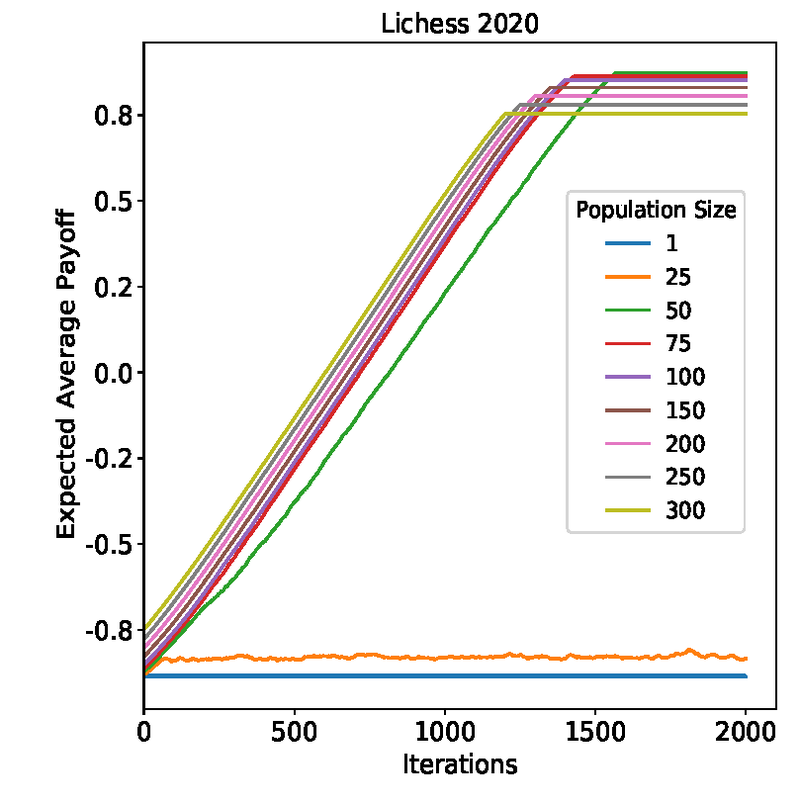
This graph shows how populations improve at chess using Fixed-Memory Fictitious Play which was done using the payoff matrices. Fictitious Play is a term in game theory which refers to learning which is done by considering the opponents responses in the past. How they used the payoff matrices from Lichess games to do this is obscure, as the paper is technical and involves math concepts. And the payoff matrices themselves are obscure.
When the population is 1 or 25, there is no progress.
But when there's 50+, the development increases linearly until it maxes out.
This shows how it is necessary to be exposed to many strategies to learn and develop. When there was a large population, they improved easily, because they were exposed to many strategies.
This allowed them to get closer to the Nash equilibrium (best play), which is a state of transitivity.
Figure 7 and Figure A1 shows that the peaks of the histograms and the bulk of the data consistently fell in the 1300–1700 Elo rating range, which matches with the range of Elo ratings in which players tend to get stuck, as stated in [38,39,40], suggesting that players tend to get stuck in this range. Furthermore, the peaks of the histograms coincided with the peak of the fitted skewed normal curve on the Nash Clustering plots. This implies that high non-transitivity in the 1300 to 1700 rating range is one potential cause of players getting stuck in this range. - Sanjaya et al.
Our discovered geometry has important implications for learning. For example, our findings provide guidance to improve the Elo ratings of human players, especially in stages with high degrees of non-transitivity (e.g., by dedicating more efforts to learning diverse opening tactics). - Sanjaya et al.
You must play all the different openings and strategies, to escape the non-transitivity trap. Otherwise you will be doomed to stay in the 1300-1700 range forever, cycling between different strategies without learning how to reach a new level.
The DeepMind paper was developed as a theory paper to improve the ability for AI-agents to reach high levels of performance. The second paper verifies the hypothesis in terms of real life play in chess. This reveals an interesting and insightful perspective on chess improvement. It requires diverse play and strategies to break free of cycling chains, where it is hard to improve as you can not know what the best way of playing is.
Sources
Real World Games Look Like Spinning Tops. Czarnecki et al. (2020)
Measuring the Non-Transitivity in Chess. Sanjaya et al. (2022)
You may also like
 RuyLopez1000
Bronstein vs Botvinnik: The Rivalry
Explore one of the Greatest Rivalries in the History of Chess RuyLopez1000
The Dark Truth Behind Lichess Studies (You are in the Matrix)
Study rankings are manipulated by 'those who know'. They may be friends, training partners or coache… jk_182
How the Evaluation and Clock impact Results of Blitz Games
Looking at Lichess games to find the effect of the remaining time and evaluation RuyLopez1000
Queen vs Rook Endgame.
How to Win Q vs R. CM HGabor
How titled players lie to you
This post is a word of warning for the average club player. As the chess world is becoming increasin… RuyLopez1000